Optimize Your Google Business Profile: 7 Steps to More Local Inquiries
How to optimize your Google Business Profile and get found better locally – 7 concrete steps plus the connection to your website. By yoolink.
Why no one is finding you right now – even though your customers are searching right around the corner
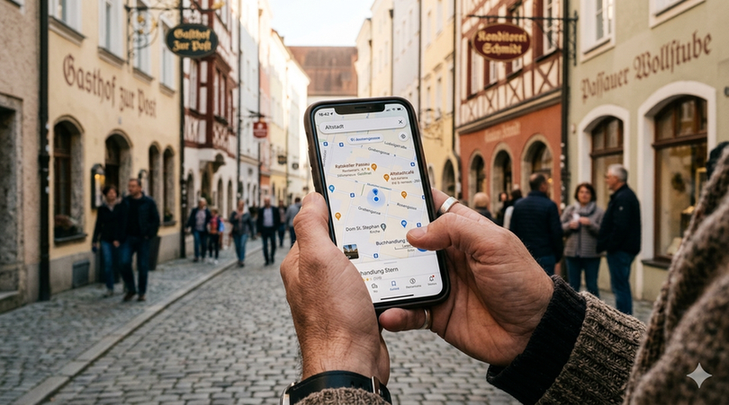
Every day, people in the Deggendorf area type "electrician near me", "hairdresser Plattling", or "restaurant Deggendorf" into their phones. Almost half of all Google searches have a local intent. And the exciting part about it: Whoever searches locally usually wants to take action immediately. Three out of four people who search for a nearby business while on the go visit it within 24 hours.
The question is also not whether your customers are searching. The question is whether they find you – or the business two streets away.
The fastest lever for this is your Google Business Profile. It decides whether you appear in the map view and in the so-called Local Pack, meaning the three entries with a map that appear right at the top above the normal search results. In this article, you will get an honest guide in seven steps: what really works, what is just a myth, and why your profile is strongest together with your website.
What you will be able to do after this article
- Create and verify your profile so that it doesn't get suspended.
- Know the seven levers that really move local ranking.
- Collect reviews systematically and in compliance with the rules.
- Avoid the most common mistakes that get profiles thrown out of the search.
- Understand why profile and website belong together.
How local ranking works – explained in 90 seconds
Google itself names three factors by which local search is sorted: Relevance, Distance, and Prominence. Relevance means how well your profile matches the search query. Distance is the proximity to the location of the searcher. Prominence describes how established your business appears online – i.e., reviews, mentions, and links.
The Whitespark study on local ranking factors from the end of 2025 had this weighted by 47 experts. The result is important for businesses to understand.
What you can influence – and what you cannot
Distance is by far the strongest factor, but you can hardly control it – your location is where it is. Everything else is in your own hands:
- Signals from the Google Business Profile are the strongest controllable category. Category, services, opening hours, and activity count here.
- Reviews have become more important compared to previous years.
- Your website also contributes noticeably to local ranking – and in the new AI search, it is even the most important factor of all.
Remember that last keyword. We will come back to it in step 5, because that is exactly where the difference between "found okay" and "reliably found" arises.
Step 1: Create and verify profile
If you don't have a profile yet, you create it for free via Google and claim your listing. If a listing already exists – this often happens automatically as soon as a business becomes known – you claim it instead of creating a second one. Two profiles for the same business is one of the most common and expensive mistakes.
Preparing for video verification
Today, Google almost exclusively verifies via video. You record a short, uncut video with your mobile phone that shows three things: that your business exists, where it is, and that you run it. In practice, this means: your company sign on a solid wall, your workspaces, your equipment, and for mobile service providers, the labeled company vehicle.
Plan this out briefly beforehand, then the recording will go smoothly in one take. The review often only takes one to two days. Important: Later changes to the name or address can trigger a new verification – so work cleanly right from the start.
Step 2: Choose the right category
This is the single most important step in the entire article. The primary category of your profile is the strongest single ranking factor for local search. It tells Google in one word what you are.
Choose as precisely as possible. "Physiotherapist" beats "Healthcare Provider". "Italian Restaurant" beats "Restaurant". The more precise the category, the better Google will match you with relevant search queries.
In addition, you can enter up to nine other categories as secondary details. Use them for real services that you actually offer – not as a wish list. A wrong or too broad primary category costs you visibility that no other step can make up for.
Step 3: Fill out the profile completely and consistently
A complete profile appears significantly more trustworthy to customers, and Google prefers active, well-maintained entries. The foundation for this is called NAP consistency: Name, Address, and Phone number must be written exactly the same everywhere – on your profile, your website, and in every business directory.
Sounds banal, but it is crucial. "Street" on the website and "St." in the profile, an old phone number in a directory, a different spelling of the company name: such little things confuse Google and weaken your ranking. More than half of consumers also avoid companies with contradictory online information.
What belongs in the profile
- Exact and complete contact details, identical to your website.
- Opening hours including holidays and special times.
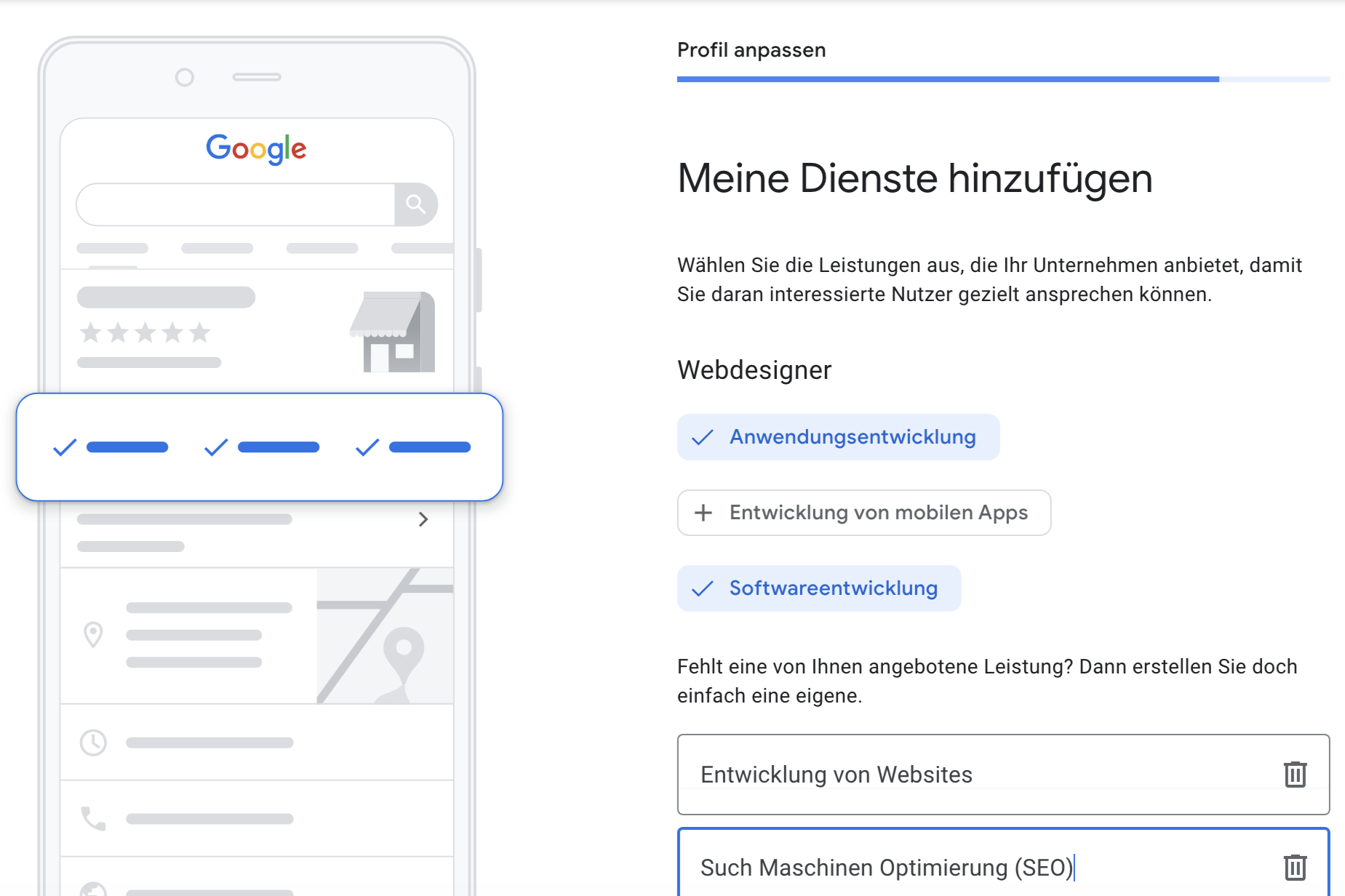
- All your services and products with clear descriptions.
- Real, up-to-date photos of rooms, team, and work.
- The link to your website – ideally to a matching subpage, not just the homepage.
What you can skip
According to Google, the profile description is not a ranking factor – write it for people, not for the search engine. And posts in the profile do not bring direct ranking, even if this is often claimed. They are still useful because they keep your profile alive and invite clicks and calls.
Step 4: Collect reviews systematically

Reviews are one of the strongest trust factors of all. Almost all consumers include reviews in their purchasing decision, and more and more people basically read them before every purchase. Just as important as the quantity is the recency today: Three out of four people want to see reviews from the last few months, not from the day before yesterday.
This means for you: Reviews are not a one-time project, but an ongoing process. A good guideline is a few new reviews per month, evenly distributed rather than in bursts.
How to ask properly
- Ask right after the job, when satisfaction is highest.
- Make it as easy as possible: a QR code on the invoice or at the counter, a direct review link via SMS or email.
- Reply to reviews – the good ones as well as the critical ones. A high response rate contributes to your ranking and shows new customers that you care.
A warning that will save you trouble
Strictly adhere to the Google rules, which will be tightened and enforced with AI support at the beginning of 2026. Prohibited is anything that buys or filters reviews: no discounts or gifts for reviews, no pre-screening of dissatisfied customers, no review tablets on site, and no requests to name employees. Violations lead to the deletion of reviews or even the suspension of the profile. Just ask all customers equally and honestly – that is allowed and comes across as the most credible.
Step 5: Why profile and website belong together
Now to the actual lever. Many businesses optimize their profile and wonder why they still aren't found consistently. The reason: The profile alone only covers a part of the searches.
Your website contributes directly to local ranking. And with the new AI-supported search – i.e., answers in Google AI Overviews, ChatGPT, or Perplexity – the website is the most important factor, even ahead of the profile. The use of AI tools for local recommendations has surged in the last year.
What happens in the background
AI systems only recommend a business when they trust it – and trust is created through matching, verifiable data. If your profile, your website, and your directory listings all say the same thing, you become the clear, recommendable address. If the data contradicts itself, you fall through the cracks.
In concrete terms, this means: local content on your website, one page per location or service, and technical markup like the LocalBusiness schema, whose data exactly matches your profile. Then both pillars work together instead of weakening each other.
This is exactly where we come in at yoolink. We set up your profile and the matching website so that they act as a unit – you can find the detailed strategy behind this in our post on local SEO and in our services.
Step 6: These mistakes will throw you out of the search
We see three mistakes over and over again with local businesses – and each one can cost you your profile.
- Keyword stuffing in the name. "Müller GmbH" becomes "Müller GmbH Electrician Deggendorf Emergency Service". This clearly violates Google's guidelines. Only your real company name is allowed. Profiles that ignore this regularly end up being completely suspended – along with all collected reviews.
- Duplicate profiles. Two listings for the same business split your signals and confuse Google. Claim and maintain a single profile.
- Outdated data. Incorrect opening hours, old phone numbers, or an address that moved long ago cost ranking and customers. A profile that is closed during the displayed opening hours measurably drops down.
If your profile does get suspended: no blind appeals. First, cross-check all data one hundred percent against your business registration and then submit the official appeal with evidence.
Step 7: Frequently asked questions about the Google Business Profile
How much does a Google Business Profile cost?
The profile is free. You invest time in setting it up and maintaining it – or have it set up. Costs only arise if you additionally run Google Ads, which is independent of the profile.
How long does it take until I am found better?
You can often see the first effects after just a few weeks, once the profile is complete and verified. Reviews and website optimization work over several months and build up over time. Local ranking is a process, not a switch.
Is the profile alone enough, or do I need a website?
For a portion of searches, the profile is enough. For consistent visibility – especially in AI searches and informative queries – you need both. Profile and website reinforce each other because search engines and AI systems reward matching data.
Can I optimize my profile myself?
Yes, you can implement the basics from this article yourself. As soon as it comes to linking with an optimized website, local landing pages, and technical markup, professional support pays off – which is exactly what we do at yoolink.
How many reviews do I need?
There is no fixed number. More important than a high total count are regular, recent reviews and honest replies to them. By the way: A perfect five-star average often looks less credible than a realistic score with genuine experiences.
Your next step
Your Google Business Profile is the fastest way to get found locally in the Deggendorf area. The seven steps here will get you a long way – the full effect unfolds when profile and website work as a unit.
This is exactly what we handle for you: We set up your profile and the matching website so that both together bring in new inquiries. If you want to know where your business currently stands and what moves the needle the most, contact yoolink – we will take a look at it together.