Website for Tradespeople: More Jobs & Applications 2026
Why Isn't Your Trades Website Generating Leads? The Essentials, Costs, and the Easy Way to Get More Jobs.

You deliver clean work, your customers are happy, your order books were full for years. Yet the phone rings less often than it used to – and finding good people has become almost impossible. If that sounds familiar, it's rarely down to your craft. It's down to how your business presents itself online.
Most tradesperson websites are digital business cards: a homepage, a bit of "About us," a phone number in the legal notice. Nice to look at, but they bring in neither new jobs nor applications. Yet in 2026 a good website is the most important tool for getting both – around the clock, without you losing time on the job site.
In this post we'll show you what a website for tradespeople really needs to do, why so many of them are ineffective, which must-haves bring in inquiries and applications, what such a website costs – and how you can even maintain it yourself in the end, without being stuck in an agency's waiting loop.
Quick Answer: What a Tradesperson Website Needs to Do
If you only have 30 seconds, here's the most important part up front. A tradesperson website brings in jobs and applications when it:
- loads in under three seconds on a smartphone – because that's where the majority of your visitors arrive today,
- immediately makes clear what you do, for whom, and in which region,
- explains each of your services in detail on its own page,
- builds trust with real project photos and reviews,
- makes getting in touch as easy as possible (click-to-call, short inquiry form),
- has its own careers or jobs section to attract skilled workers,
- and gets found locally on Google in your region.
Everything else is window dressing. Anyone who implements these points cleanly stands out from 90% of the competition. Let's now look at why that is, in detail.
Why 9 Out of 10 Tradesperson Websites Deliver No Inquiries
Having a website has long been standard in the trades – according to a Bitkom study, the vast majority of businesses now have an online presence. So the problem is rarely whether a website exists, but rather what it achieves. And that's where the wheat is separated from the chaff.
Mistake 1: The website is a business card, not a sales tool. Many sites describe the company ("We are a third-generation family business…") instead of solving the customer's problem ("Broken heating? We'll be there within 24 hours."). In the first few seconds, visitors only ask themselves one thing: Can this person help me, and how do I reach them? Anyone who doesn't give an immediate answer loses the prospect to the next result.
Mistake 2: No clear positioning. "We do everything" sounds like flexibility but comes across as arbitrary. A customer looking for a tiler wants to see a tiler – not a list of 30 trades. Clarity beats completeness.
Mistake 3: The website can't be found. If your site ranks on page three for "electrician Deggendorf," it practically doesn't exist for the customer. Around 46% of all Google searches have local intent – anyone who isn't visible here is giving away exactly the ready-to-buy inquiries from their own region.
Mistake 4: It ignores the second major bottleneck – staff. The skilled-worker shortage in the trades is dramatic: the German Confederation of Skilled Crafts (ZDH) estimates the number of vacant positions at 200,000 to 250,000. Open trade positions remain unfilled for around 224 days on average – more than twice as long as in 2015. In plumbing, heating, and air-conditioning (SHK) trades, according to the Federal Employment Agency, it's even close to 300 days. A website that only thinks about customers leaves the second decisive lever completely unused.
The good news: every one of these mistakes is avoidable. That's exactly what the must-haves in the next section are for.
The Must-Haves: What a Tradesperson Website Needs in 2026
1. Every Service on Its Own Page
A single page listing "bathrooms, heating, plumbing, maintenance" in one paragraph ranks for none of them properly on Google – and convinces no customer either. Better: one detailed page per service. A "Bathroom Renovation" page, a "Heating Replacement" page, an "Emergency Service" page.
This has two effects: Google understands exactly what you're an expert in and shows you for the matching search queries. And the customer specifically looking for a bathroom renovation lands on a page that addresses exactly their concern – with a much higher probability that they'll get in touch. This structure is at the same time the basis for local landing pages ("Bathroom Renovation Deggendorf"), with which you appear right at the top regionally.
2. Reference Photos of Real Projects
Stock photos of flawless model bathrooms are recognized by everyone today – and they build no trust. Real photos of your own projects, on the other hand, are worth their weight in gold: the renovated bathroom of the family from Plattling, the freshly re-tiled roof surface, the laid tiles in detail. Before-and-after photos work especially well. They prove quality without you having to say a single word about it.
3. Display Reviews Visibly
Reviews are one of the strongest trust and conversion factors of all in 2026. According to the BrightLocal study, 97% of consumers read reviews about local businesses, and 31% only hire businesses with 4.5 stars or more. Notably: willingness to buy is not highest at a flawless 5.0, but in the range of 4.2 to 4.5 stars – because seamless perfection comes across as implausible to many.
Embed your real Google reviews directly on the website, ideally on the homepage and the service pages. This convinces visitors at exactly the moment when they're still hesitating.
4. Click-to-Call and a Short Inquiry Form
More than half of your visitors come from a smartphone. Anyone who first has to copy your phone number out of the legal notice there won't call. A clickable phone number (click-to-call) solves exactly that: one tap and the connection is made.
For everyone who doesn't want to call, you need a short inquiry form. Short means short: name, concern, contact option – done. Every additional mandatory field costs inquiries. A WhatsApp contact can be a useful addition, because many customers perceive it as the lowest-threshold way to get in touch.
5. A Real Careers and Jobs Section
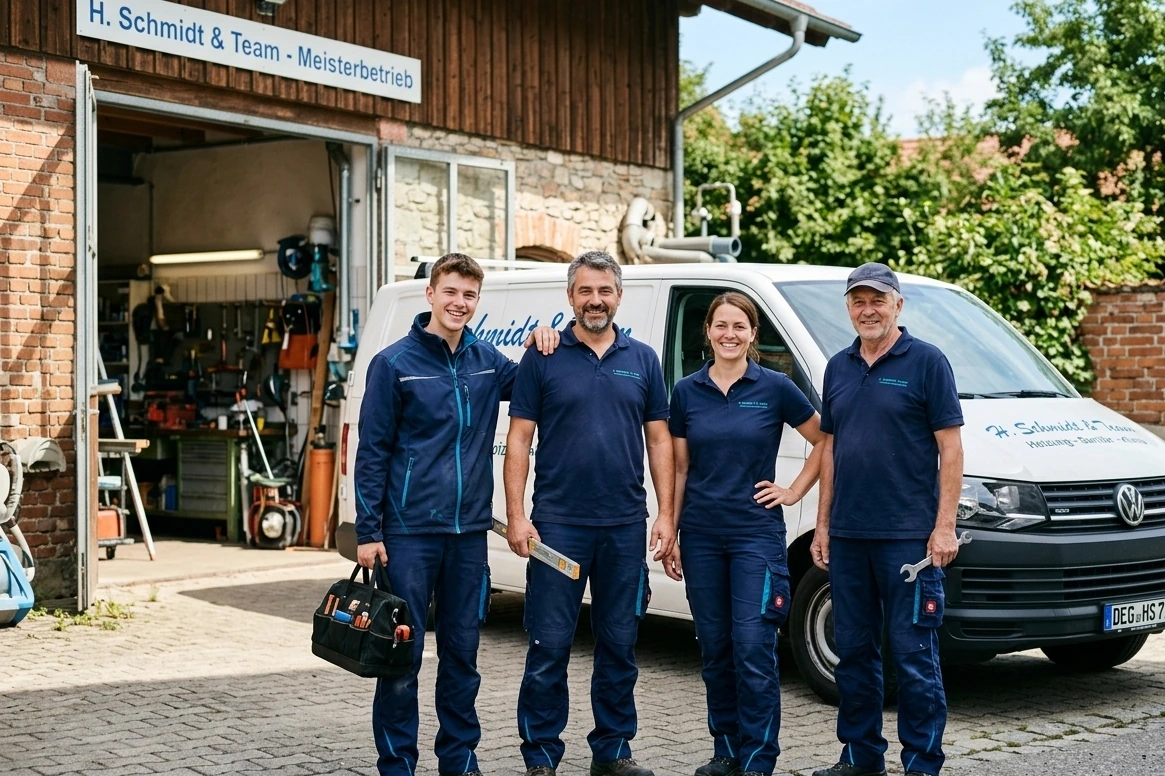
This is the point almost everyone forgets – and the one that sets you apart from the competition right now. With 200,000+ open positions and over 16,000 unfilled apprenticeship places in 2025, your website is your best recruiter. Traditional channels like newspaper ads and notices barely reach the upcoming generation anymore – they search online.
A good careers section doesn't just say "We're looking for journeymen," but makes people want to work for the business: a few sentences on why it's worth working for you, photos of the team and the daily work, concrete benefits (fair pay, regular hours, modern equipment, further training), and a simple application form, ideally without the annoying requirement of a cover letter. A website that appeals to customers and applicants works double for you.
6. A Clear Message
The area a visitor sees without scrolling is what decides. That's where, in one sentence, what you do and for whom belongs, plus a clearly visible button ("Request now" / "Book an appointment"). No slider with ten messages, no welcome text – one clear statement and one clear next step.
Getting Found Locally
The best website is useless if no one finds it. For trade businesses, local SEO is the most important visibility lever, because your customers search regionally: "roofer near me," "painter Deggendorf," "plumbing emergency service Lower Bavaria."
The three most important building blocks in brief:
- Google Business Profile set up and maintained completely – with the correct primary category, opening hours, real photos, and continuous reviews. It's the single strongest lever for appearing in the Google map box.
- Consistent contact details (name, address, phone) on the website, Google profile, and in directories – exactly identical everywhere.
- Local landing pages for each location and service with unique content.
Because this topic is so important, we've dedicated a separate, detailed post to it: Local SEO for Businesses in Deggendorf & Lower Bavaria shows you step by step how to land right at the top of Google regionally. How to optimize your Google profile in detail can be read in the post Optimizing Your Google Business Profile.
Mobile & Fast: More Than Half of Visitors Come From a Smartphone
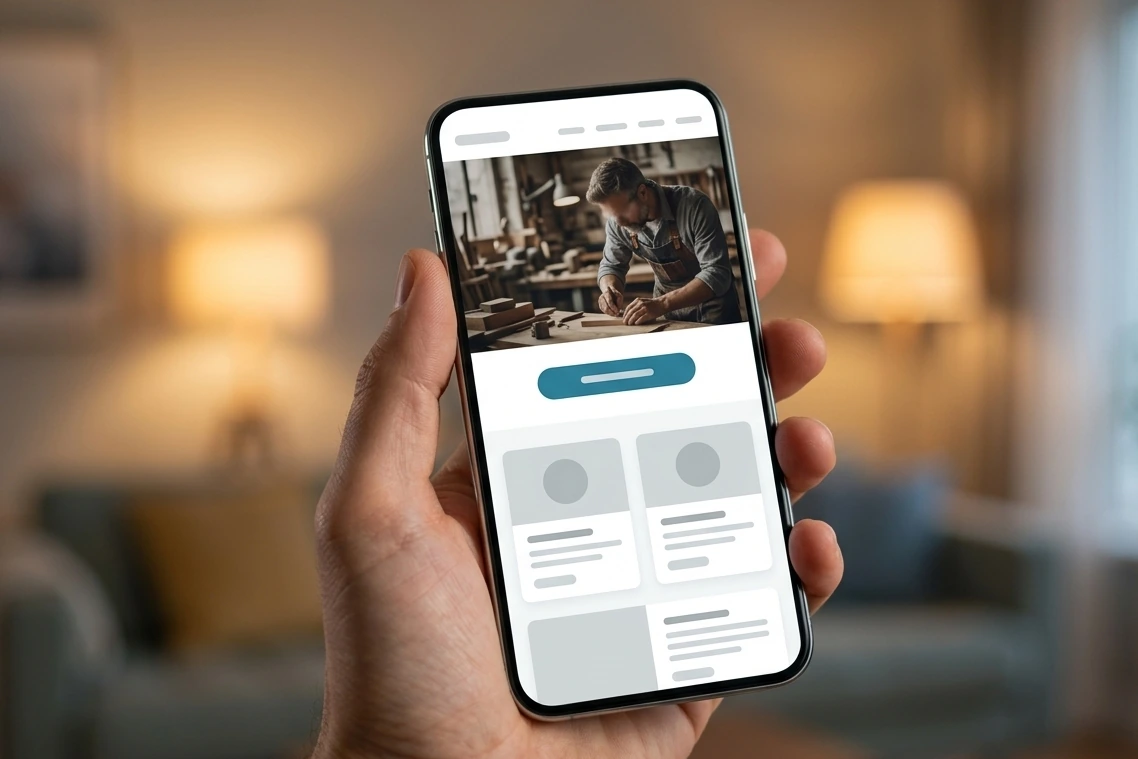
Around 57% of all local searches take place on a smartphone – and especially with trade services this share is often even higher, because people search exactly when the problem is acute: a burst pipe on a Sunday evening, the heating out in winter, a broken tile right before guests arrive.
What this means for your website:
- Speed: If your page takes longer than three seconds to load, many visitors bounce again. Fast loading time is not a nice-to-have, but directly decides over inquiries.
- Mobile first: Buttons big enough to tap, phone number immediately reachable, forms with few fields, easily readable text without zooming.
- Availability around the clock: Studies show that customers today expect fast responses and constant availability. Your website is the channel that delivers that – even at 10 p.m., when no one answers the phone anymore.
A technically clean, mobile-optimized site is therefore not a design luxury, but the basic prerequisite for visitors to even become inquiries.
Maintain It Yourself Instead of an Agency Waiting Loop
A legitimate concern of many tradespeople: "If something changes – new opening hours, a new project photo, a job opening – do I then have to call the agency every time, pay, and wait for days?"
The answer should be a clear no. A modern tradesperson website is built with a simple content management system (CMS) that lets you make small changes yourself – as uncomplicated as writing a message. Update a job posting, upload a fresh reference photo, adjust prices, enter vacation times: all in a few minutes, without technical knowledge and without waiting.
That's exactly our approach at yoolink: we build the website professionally and hand it over to you with a system you'll have under control afterward. You're independent, save ongoing costs for little things – and for anything bigger we're of course still by your side.
What Does a Tradesperson Website Cost?
The honest answer is: it depends – but it doesn't have to be an incalculable risk. In general, very different prices circulate on the market, because "website" can mean anything: from a clicked-together site builder to an individually developed, search-engine-optimized site.
What really matters when it comes to costs:
- Scope: How many service pages, a careers section, review integration, local landing pages?
- Individuality: An off-the-shelf template or a design that fits your business?
- Findability: Is the site optimized for local search from the ground up, or just "online"?
- Follow-up costs: Are hosting, maintenance, and ease of upkeep included – or does a surprise come every month?
Our tip: pay less attention to the lowest starting price and more to what comes out of it in the end. A website that brings you just one additional job a month has, in many trades, already paid for itself after a short time. That's exactly why at yoolink we work with a fair price – including hosting and a CMS you can maintain yourself. You know from the start what you're getting and what it costs. No hidden items, no nasty surprises.
Frequently Asked Questions About the Tradesperson Website (FAQ)
How long does it take until my website is finished? That depends on the scope, but a professional tradesperson website can usually be implemented within a few weeks – provided the texts, logo, and project photos are available. We'll guide you through it and take the bulk of the work off your hands, so your daily business doesn't suffer.
Can I change content myself later? Yes. We hand over the website to you with a simple CMS that lets you update texts, images, job postings, and opening hours yourself – without programming knowledge and without having to wait for an agency.
Is the website legally secure (legal notice, privacy, GDPR)? A professionally created website includes a legal notice and privacy policy and is built to be technically GDPR-compliant (e.g., correct integration of the contact form and maps). This significantly reduces the risk of warnings. It doesn't replace the final legal review of your individual content, but the foundation is solid.
Will a website also bring me applications? Definitely – if it has a real careers section. Given the current skilled-worker situation, applicants search online for employers. An inviting jobs section with team photos, clear benefits, and a simple application form makes your website one of your strongest recruiting channels.
Do I also need social media? Social media can complement, but doesn't replace a website. Your website is the place that belongs to you, that ranks on Google, and that all other channels feed into. It's the foundation – social media is the bonus.
Is it worth it even for a small business in the countryside? Especially then. In rural areas, online competition is often lower, while customers still search on Google first. Anyone who shows up first here with a good, locally optimized website secures a large share of the regional inquiries.
Ready for a Website That Really Works?
In 2026 a tradesperson website is far more than a digital business card. Done right, it's both your best salesperson and your best recruiter at once – seven days a week, around the clock. It brings you inquiries from your region and helps you find the good people the market otherwise barely provides.
The difference between a website that merely exists and one that brings in jobs and applications lies in the details: clear positioning, dedicated service pages, real photos, visible reviews, easy contact options, a strong careers section – and local visibility on Google.
👉 Want a tradesperson website that brings in inquiries AND applications? Get your no-obligation quote. We here in Deggendorf know the region, the trades, and what works online – and we'll tell you transparently what your website would cost and what it can bring you.